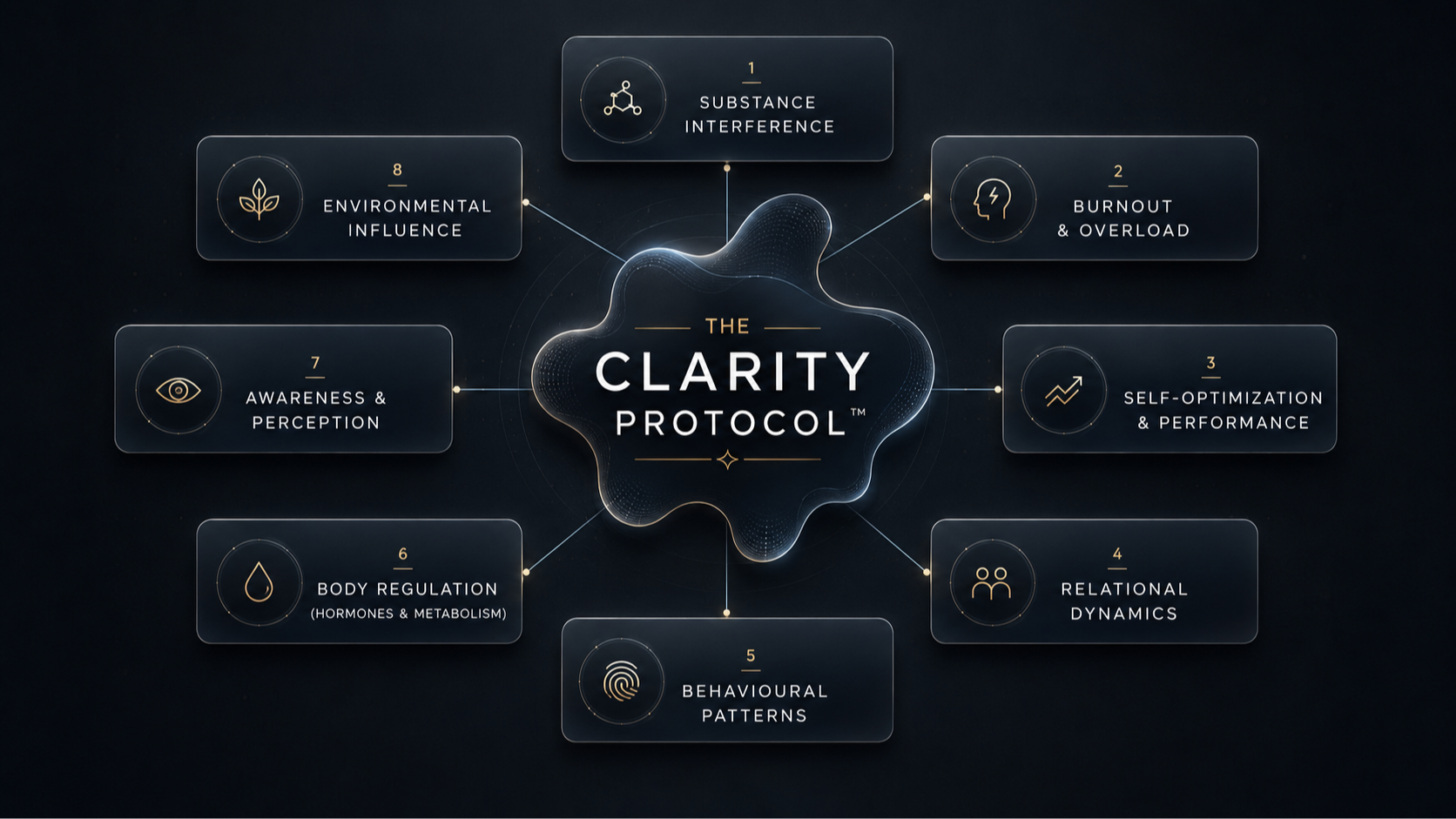
CLARITY PROTOCOL™ — GATEWAY
Relational Dynamics
When relationship pressure, emotional obligation, conflict, guilt, resentment,
or approval-seeking starts affecting your clarity, consistency, and decision reliability.
Some interference does not come from substances, burnout, or lack of discipline.
Sometimes the interference comes from the relationships, roles, expectations, and emotional patterns that quietly shape how you think, respond, decide, and operate.
This gateway is for the person who can feel the cost of constantly managing people, avoiding conflict, carrying resentment, over-explaining themselves, keeping peace, or making decisions through someone else's reaction.
This is not relationship counselling.
This is not emotional processing for its own sake.
This is clarity infrastructure for people who are ready to stop making decisions from guilt, tension, fear, resentment, obligation, or relational pressure.
BEGIN INTAKE
Clear Scope Declaration
Clarity Protocol™ is a standards-based, facilitated cohort system designed to restore clarity, consistency, and decision reliability. Clarity Protocol™ is not psychotherapy, addiction treatment, medical care, detox support, psychiatric care, or crisis intervention. We do not diagnose substance use disorders, manage withdrawal, provide medical advice, treat addiction, process trauma, or replace licensed healthcare providers. This boundary is intentional. It protects participants, organizations, families, and the integrity of the system. This gateway is designed for stable, reflective adults who are ready to examine how alcohol, substances, or compulsive coping patterns may be interfering with clarity, standards, identity alignment, and decision reliability. If medical withdrawal risk, addiction treatment, psychiatric support, or crisis support is required, participants must seek appropriate licensed care before enrolling.
This gateway is built for people who keep losing clarity inside relationship patterns.
Relational interference is often misunderstood because it does not always look dramatic from the outside.
You may not be in obvious crisis. You may not be yelling, collapsing, walking away, or falling apart.
You may simply be exhausted from managing emotional tension.
You may be constantly adjusting your tone, your plans, your standards, your goals, or your behaviour
to avoid conflict, gain approval, reduce someone else's reaction, or keep a situation stable.
Over time, that becomes expensive — not always financially, but expensive in energy, in confidence,
in clarity, in self-trust, and in decision integrity.
You start asking different questions.
Not "What is aligned?" but "How will they react?"
Not "What is true?" but "How do I keep this from becoming a problem?"
Not "What standard do I want to live from?" but "What will create the least conflict?"
That is where relational dynamics become interference.
What This Looks Like in Real Life
Relational interference rarely announces itself as a major breakdown.
It often shows up quietly through patterns like:
- You keep saying yes when you already know you mean no.
- You avoid difficult conversations until resentment builds.
- You explain yourself too much because you want to be understood or approved of.
- You make decisions based on someone else's mood, reaction, opinion, or disappointment.
- You carry emotional weight that belongs to other people.
- You keep returning to the same conflict pattern even though you understand it intellectually.
- You feel guilty when you choose yourself, your standards, or your future.
- You feel responsible for keeping everyone around you stable.
- You are calmer and clearer alone than inside certain relationships.
- You feel confident in isolation but unclear inside specific relational dynamics.
- You tolerate conversations, behaviour, or expectations that quietly lower your standards.
- You become reactive, defensive, withdrawn, or overly accommodating.
- You mistake peacekeeping for maturity.
- You confuse loyalty with self-abandonment.
- You keep choosing short-term harmony over long-term truth.
This does not mean the people around you are the problem. Sometimes they are.
Often, the deeper issue is the decision pattern you have built around them.
Clarity Protocol™ exists for the person who is ready to restore internal authority — without needing to blame, attack, collapse, or disappear.
The interference is not always the relationship. Sometimes it is the operating pattern inside the relationship.
Many people try to solve relational interference by changing the other person. That may be necessary in some situations,
but Clarity Protocol™ starts with a different question:
What happens to your clarity when this relationship, role, expectation, conflict, or emotional pattern gets activated?
Do you become smaller?
Do you become reactive?
Do you abandon your standards?
Do you avoid the truth?
Do you perform calm while carrying resentment?
Do you over-function so others do not have to grow?
Do you seek approval from people who benefit from your uncertainty?
Relational interference is not just about people.
It is about how your identity, standards, communication, and decisions shift when relational pressure enters the room.
That is the work. Not blaming others. Not pretending everything is fine.
The work is restoring enough clarity that you can remain aligned
while still being connected.
Who This is For
- You are functional, but relationships are costing you clarity.
- You feel pulled between who you are becoming and who others expect you to remain.
- You often make decisions based on guilt, fear, conflict avoidance, or emotional obligation.
- You are tired of repeating the same communication patterns.
- You feel resentment building because you have not been honest about your limits.
- You want stronger boundaries without becoming harsh or disconnected.
- You want to stop over-explaining, over-functioning, or over-adjusting.
- You want to make decisions from alignment instead of reaction.
- You are ready to examine your own part in recurring relational patterns.
- You want standards, language discipline, and forward identity inside relationships.
Who This is Not For
- This gateway is not for people seeking emergency intervention, domestic violence support, couples mediation, trauma therapy, psychiatric care, addiction treatment, or legal advice.
- It is not for anyone who wants Clarity Protocol™ to fix another person.
- It is not for anyone looking to weaponize language against a partner, family member, or colleague.
- It is not for people who want validation without responsibility or who are unwilling to examine their own decision patterns, communication habits, and emotional responses.
- When licensed support, crisis support, medical support, safety planning, or legal advice is appropriate, those resources must be used first.
- This gateway is for stable, reflective adults who are ready to restore clarity, identity alignment, and decision integrity inside relational pressure.
This gateway is especially relevant for high-functioning adults, leaders, parents, partners, caregivers, entrepreneurs, and professionals who are carrying responsibility for other people while quietly losing personal clarity in the process.
BEGIN INTAKEThis is not about becoming less caring. It is about becoming less compromised.
A common fear inside relational work is that boundaries will make someone selfish, cold, or disconnected.
That is not the point.
The point is not to care less. The point is to stop allowing care, loyalty, guilt, fear, obligation, resentment, or approval-seeking to distort your decisions.
Clarity does not remove love. Clarity strengthens love by removing confusion, performance, emotional debt, and hidden resentment.
It helps you ask cleaner questions:
What is mine to carry?
What is not mine to carry?
What standard am I abandoning here?
What truth am I avoiding?
Where am I calling it kindness when it is actually self-abandonment?
Where am I calling it loyalty when it is actually fear?
Where am I calling it peace when it is actually avoidance?
That is where clarity begins.

How It Works

1. Complete the intake questionnaire
You identify the primary pattern affecting your clarity, execution, and decision reliability. The intake takes approx. 10–15 minutes and is the starting point for determining which gateway is accurate for your situation.

2. Internal review and gateway determination
Your intake is reviewed to confirm whether Relational Dynamics is the right entry point for your situation.

3. Next-step invitation and onboarding if aligned
If there is alignment, you receive an invitation into the appropriate next step and are oriented to the Clarity Protocol™ structure.

4. Enrolment and implementation.
You begin applying the framework through structured reflection, interference mapping, language discipline, identity stabilization, environmental design, and standards-based decision-making.
What Begins to Change
The first shift is usually not that the relationship suddenly transforms.
The first shift is that your relationship to the pattern changes.
Participants begin to notice:
- They can name the pattern without drowning in it.
- They pause before reacting, explaining, defending, or appeasing.
- They recognize guilt as a signal — not a command.
- They stop confusing someone else's disappointment with personal failure.
- They become more honest about resentment, limits, and expectations.
- They make cleaner decisions without needing everyone to agree.
- They communicate with more precision and less emotional leakage.
- They see where they have been participating in the loop.
- They begin restoring self-trust through aligned action.
The goal is not relational perfection.
The goal is decision reliability under relational pressure.
Begin with the intake.
If relational pressure, emotional obligation, conflict, guilt, resentment, or approval-seeking is interfering with how you think, decide, communicate, or operate — begin with the intake.
The intake helps determine whether Relational Dynamics is the right gateway or whether another Clarity Protocol™ entry point is more accurate for where you are right now.
There is no obligation after the intake. There is an honest assessment of fit.
⚠️ Crisis Support Disclaimer Important Notice: