CLARITY PROTOCOL™ — GATEWAY
Leadership Burnout
When sustained pressure, responsibility, cognitive load, emotional labour, and decision fatigue
begin reducing your clarity, presence, patience, standards, and reliability under pressure.
Burnout is not always collapse.
Sometimes it is reduced command.
You are still working. Still producing. Still answering. Still leading. Still carrying responsibility.
But the quality of your presence, decisions, patience, communication, and standards is no longer where it should be.
This gateway is built for leaders and high-responsibility adults who are done coping and ready to restore operational clarity.
This is not emotional processing. This is not generic stress management. This is clarity infrastructure for reliability under pressure.
BEGIN INTAKE
Clear Scope Declaration
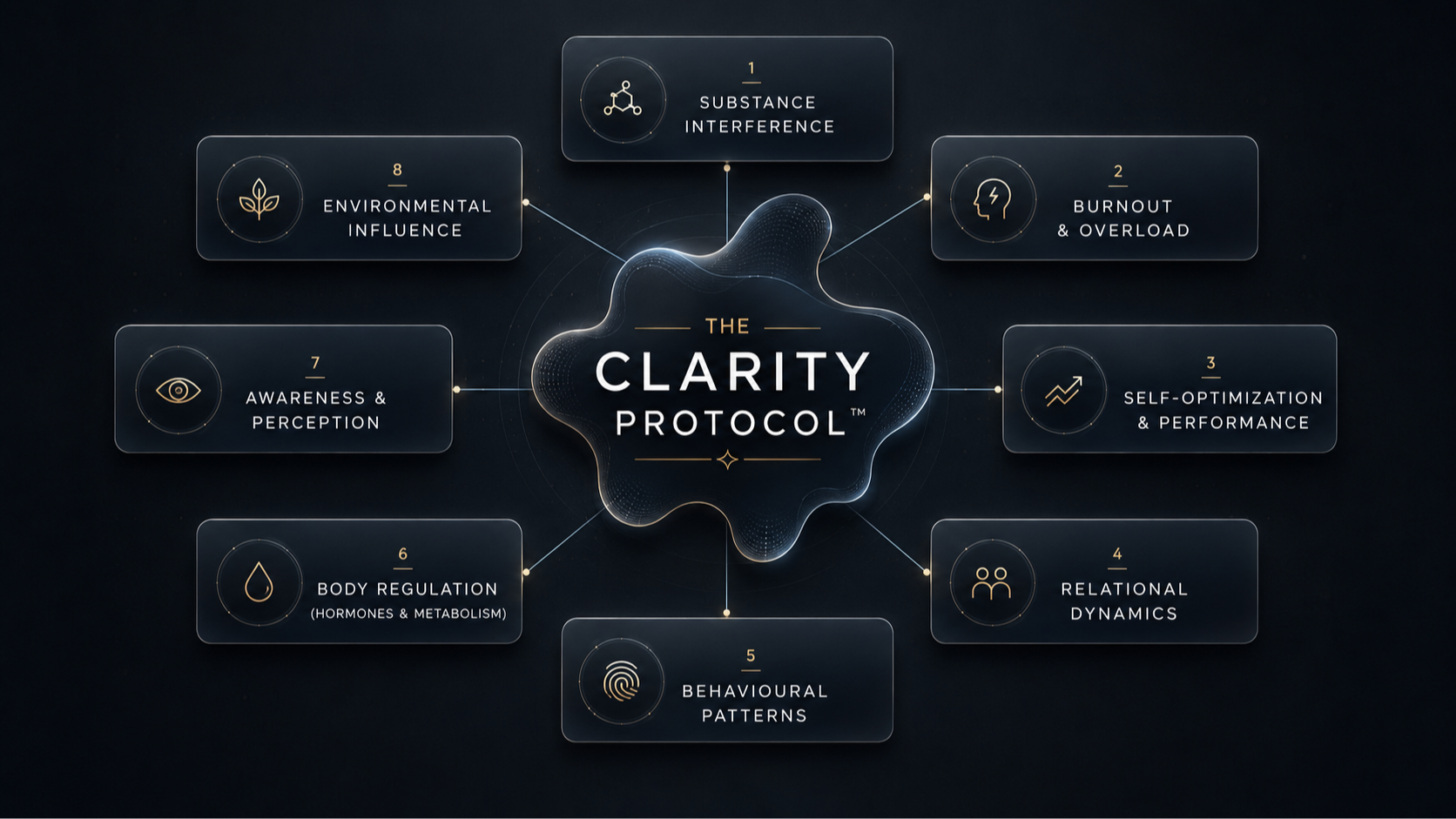
Clarity Protocol™ is a standards-based, facilitated cohort system designed to restore clarity, consistency, and decision reliability. Clarity Protocol™ is not psychotherapy, addiction treatment, medical care, detox support, psychiatric care, or crisis intervention. We do not diagnose substance use disorders, manage withdrawal, provide medical advice, treat addiction, process trauma, or replace licensed healthcare providers. This boundary is intentional. It protects participants, organizations, families, and the integrity of the system. This gateway is designed for stable, reflective adults who are ready to examine how alcohol, substances, or compulsive coping patterns may be interfering with clarity, standards, identity alignment, and decision reliability. If medical withdrawal risk, addiction treatment, psychiatric support, or crisis support is required, participants must seek appropriate licensed care before enrolling.
This gateway is built for people who are still producing — but no longer leading from full clarity.
Leadership burnout often hides behind competence.
People keep relying on you.
The business still needs you.
The team still expects answers.
The family still needs decisions.
The phone still rings.
The calendar still fills.
The problems still arrive.
Because you can carry responsibility, people assume you are fine. Sometimes you assume the same thing.
But the signs are there.
Your fuse is shorter.
Your recovery is slower.
Your patience is thinner.
Your decision speed changes.
Your standards become negotiable.
Your emotional availability drops.
Your leadership becomes reactive instead of clear.
You may still be in the room — but you are not operating with the command you expect from yourself.
This gateway does not ask, "Are you exhausted enough to stop?"
It asks, "Is pressure reducing your reliability?"
What This Looks Like in Real Life
Leadership burnout is not always exhaustion. Sometimes it is inconsistency.
It often shows up through patterns like:
- Shorter fuse, less patience, and less presence with the people who matter.
- Decision avoidance, decision delay, or constant second-guessing.
- Lower standards tolerated in yourself or in others.
- Leadership drift — you are present, but not fully in command.
- Reduced emotional availability at home after carrying full responsibility all day.
- Irritability over issues that used to feel manageable.
- Losing the ability to distinguish urgent from important.
- Saying yes because it is easier than having the hard conversation.
- Feeling mentally full before the day has even begun.
- Becoming reactive instead of strategic.
- Over-functioning because others have become dependent on your capacity.
- Protecting everyone else's stability while privately losing your own.
- Treating rest as weakness or delay.
- Feeling resentment because responsibility has become one-sided.
- Performing well in public while privately wondering how long you can sustain this.
Many people call it stress.
Clarity Protocol™ calls it reliability under pressure.
The issue is not pressure alone. The issue is what pressure is doing to your decision quality.
High-responsibility people often normalize overload.
They tell themselves: "This is just leadership."
"This is what responsibility looks like."
"I cannot drop the ball."
"I will rest when things slow down."
"I just need to push through."
But the real issue is not whether you can keep pushing.
The real issue is whether pushing is reducing your ability to lead clearly.
Pressure changes people.
It compresses thinking.
It narrows emotional bandwidth.
It increases reactivity.
It weakens patience.
It makes avoidance look strategic.
It makes emotional shutdown look professional.
This is why Clarity Protocol™ does not treat burnout as a vague wellness problem.
It treats it as interference affecting decision architecture.
The leader does not just need rest.
The leader needs restored clarity, standards, boundaries, identity alignment, and reliability under pressure.
Who This is For
- Your output still exists, but your clarity and consistency are slipping.
- You feel a gap between who you are and how you are showing up.
- You are tired of coping and want a standards-based operating system.
- You want language discipline, decision reliability, and identity stabilization.
- You are carrying responsibility that few people fully see.
- Your patience, presence, or communication is being affected by sustained pressure.
- You are avoiding decisions, conversations, or standards because you are overloaded.
- You are still performing, but the internal cost is increasing.
- You want to lead from clarity rather than reactivity.
- You want to stop confusing endurance with alignment.
Who This is Not For
- This gateway is not for people seeking medical treatment, psychiatric care, crisis intervention, workplace disability support, addiction treatment, emergency care, or clinical burnout treatment.
- It is not for people with urgent medical or psychological symptoms who require licensed support.
- It is not for leaders who want better language but no change in behaviour, boundaries, standards, or decision patterns.
- It is not for people looking for generic stress tips, wellness inspiration, or productivity hacks.
- When licensed medical, psychological, psychiatric, occupational health, or emergency support is appropriate, those resources must be used.
- This gateway is for stable, reflective adults who are ready to examine burnout as interference affecting clarity, standards, identity, and decision reliability.
This gateway is especially relevant for founders, executives, entrepreneurs, managers, professionals, first responders, caregivers, parents, and operators whose responsibility load has begun affecting their internal command.
Endurance is not the same as alignment.
A lot of high-responsibility people are praised for endurance. They can take more. Carry more. Absorb more. Lead more.
But endurance can become dangerous when it replaces clarity.
Just because you can keep going does not mean you are operating well. Just because people depend on you does not mean the current model is sustainable. Just because you are strong does not mean the pressure is not changing your decision quality.
Clarity Protocol™ asks more precise questions:
Where is pressure reducing my reliability?
What responsibilities have become identity traps?
What standards have I lowered because I am overloaded?
What conversations am I avoiding because I am tired?
What am I calling leadership when it is actually over-functioning?
What am I calling strength when it is actually depletion?
This is not about doing less because life is hard. It is about operating better because responsibility matters.

How It Works

1. Complete the intake questionnaire
Identify the primary pattern affecting your clarity, consistency, and decision reliability under pressure.

2. Internal review and gateway determination
Your intake is reviewed to confirm whether Leadership Burnout is the right entry point or whether another gateway better fits your situation.

3. Next-step invitation and onboarding if aligned
If there is alignment, you receive an invitation into the appropriate next step and are oriented to the Clarity Protocol™ structure.

4. Enrolment and implementation.
You begin applying the framework through structured reflection, interference mapping, language discipline, identity stabilization, environmental design, and standards-based decision-making.
What Begins to Change
The first shift is not immediate relief from responsibility.
The first shift is clearer command inside responsibility. Participants begin to notice:
- They recognize pressure patterns earlier.
- They stop treating overload as proof of importance.
- They identify where decision quality is slipping.
- They restore cleaner standards around time, attention, communication, and boundaries.
- They stop confusing over-functioning with leadership.
- They become more precise about what actually requires their energy.
- They communicate with less reactivity and more authority.
- They make fewer decisions from depletion.
- They begin rebuilding self-trust as a leader under pressure.
The goal is not a life without responsibility.
The goal is restored reliability inside responsibility.
Begin with the intake.
If sustained pressure, responsibility, cognitive load, emotional labour, or decision fatigue is interfering with your clarity, presence, patience, standards, or leadership reliability — begin with the intake.
The intake helps determine whether Leadership Burnout is the right gateway or whether another Clarity Protocol™ entry point is more accurate
⚠️ Crisis Support Disclaimer Important Notice:
Clarity Protocol™️ is a non-clinical identity stabilization system and does not provide therapy, treatment, or medical services. The Clarity Protocol™, Unshakeable Mindset, and related programs are not designed for crisis intervention, emergency care, or acute mental health treatment. If you or someone you know is experiencing immediate distress, thoughts of self-harm, or is in danger, please contact local emergency services or one of the crisis resources listed in the YouMattyr Foundation Crisis page. Participation in these programs assumes a level of personal stability appropriate for reflective, coaching-based work.