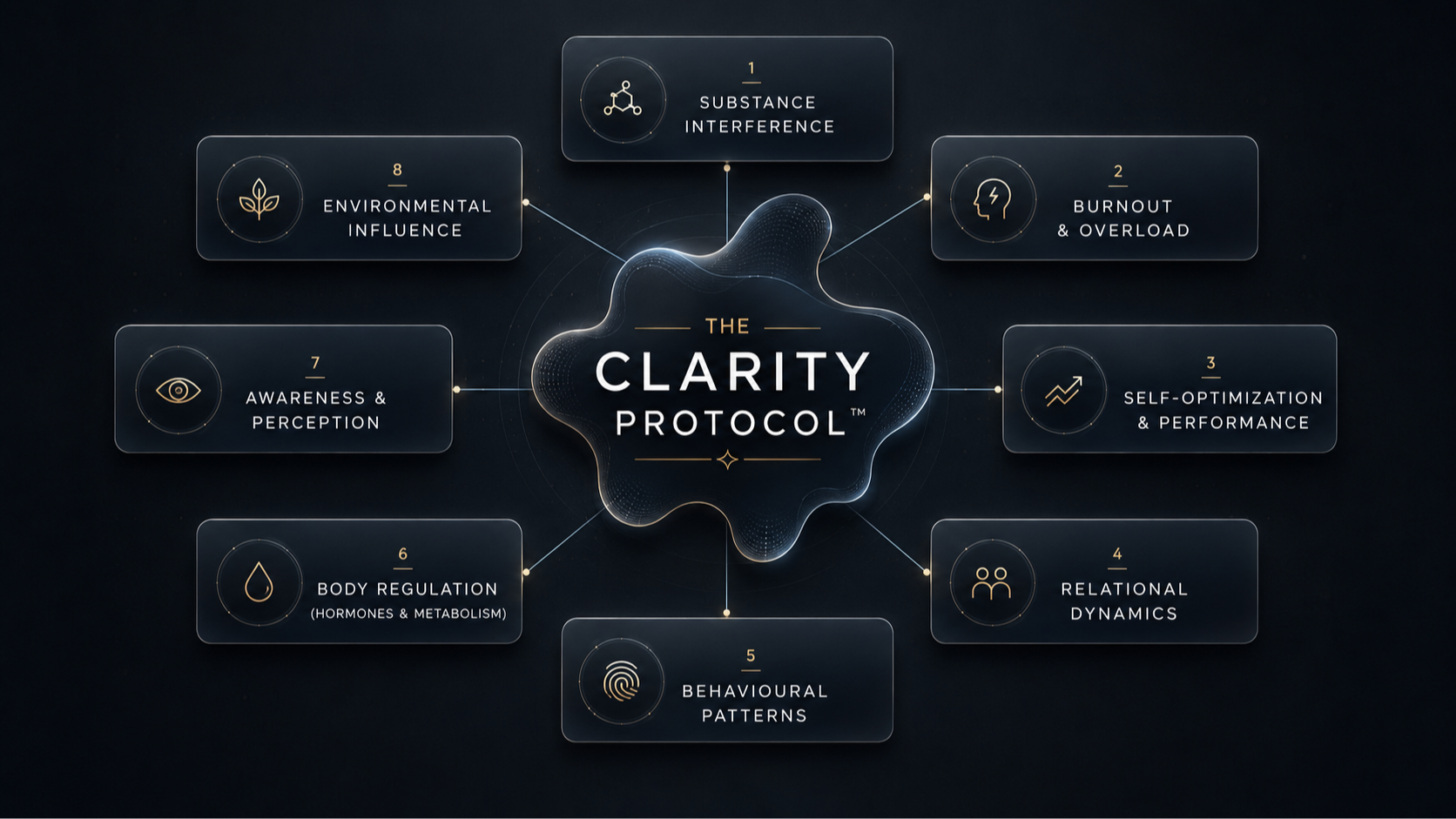
CLARITY PROTOCOL™ — GATEWAY
Awareness & Perception
When the way you interpret situations, people, pressure, conflict, opportunity, culture or even yourself
begins affecting your clarity, reactions, confidence, communication, and decision reliability.
Not all interference comes from what is happening around you.
Sometimes interference comes from the lens you are using to interpret what is happening
— a lens shaped over time by personal experience, emotional patterning, social conditioning,
cultural expectations, and repeated assumptions.
A situation occurs.
A meaning gets assigned.
A reaction follows.
A decision gets made.
A pattern repeats.
This gateway is for the person who is ready to examine whether their assumptions, internal narratives, emotional filters,
self-perception, inherited conditioning, or interpretation patterns are shaping decisions more than they realize.
This is not mindset motivation. This is not therapy.
This is clarity infrastructure for the lens behind the decision.
BEGIN INTAKE
Clear Scope Declaration
Clarity Protocol™ is a standards-based, facilitated cohort system designed to restore clarity, consistency, and decision reliability. Clarity Protocol™ is not psychotherapy, addiction treatment, medical care, detox support, psychiatric care, or crisis intervention. We do not diagnose substance use disorders, manage withdrawal, provide medical advice, treat addiction, process trauma, or replace licensed healthcare providers. This boundary is intentional. It protects participants, organizations, families, and the integrity of the system. This gateway is designed for stable, reflective adults who are ready to examine how alcohol, substances, or compulsive coping patterns may be interfering with clarity, standards, identity alignment, and decision reliability. If medical withdrawal risk, addiction treatment, psychiatric support, or crisis support is required, participants must seek appropriate licensed care before enrolling.
This gateway is built for people who are ready to question the lens — not just the situation.
Most people do not experience their perception as perception. They experience it as truth.
They believe they are simply seeing things clearly. Sometimes they are.
But sometimes the mind is filtering reality through old experiences, emotional protection, fear, frustration, insecurity, resentment, pride, comparison, control, survival logic, inherited assumptions, social conditioning, or cultural narratives that have gone unquestioned for years.
That filter affects everything.
It affects how you hear feedback. It affects how you read tone.
It affects how you interpret opportunity. It affects whether you trust people.
It affects how quickly you become defensive. It affects how you explain your own behaviour.
It affects what you believe is possible. It affects whether you act from truth — or from the story attached to truth.
Awareness & Perception is not about pretending everything is positive. It is not about forcing optimism over reality.
It is about seeing clearly enough to recognize where your perceptions were shaped for you — and where distortion may be influencing your decisions, identity, reactions, and direction.
What This Looks Like in Real Life
Perceptual interference rarely announces itself as distortion.
It often shows up quietly through patterns like:
- You assume you know what someone meant before seeking clarity directly.
- You react to tone, facial expression, timing, silence, or social cues as if your interpretation is fact.
- You make decisions through old experiences, conditioning, or emotional memory that may no longer apply to the present situation.
- You see opportunity but immediately explain why it will not work.
- You call it wisdom or realism when it may actually be fear protecting itself.
- You confuse certainty with clarity when it may actually be defensiveness or control.
- You tell yourself you are being realistic when you may be protecting yourself from disappointment, uncertainty, or change.
- You interpret feedback as criticism, disrespect, rejection, or personal threat before evaluating it objectively.
- You compare yourself to others and lose connection to your own direction, standards, or identity.
- You keep seeing yourself through an outdated identity shaped by past experiences, roles, expectations, or conditioning.
- You overthink until clarity becomes impossible and inaction begins to feel safer than movement.
- You interpret conflict as danger instead of information.
- You keep looking for evidence that confirms the story, assumption, or worldview you already believe.
- You feel stuck but continue defending the lens that keeps you there.
- You are intelligent enough to rationalize the pattern — which is exactly what makes it difficult to interrupt.
This does not mean your perception is always wrong. It means it is worth examining.
Clarity Protocol™ exists for the person who wants to see clearly enough to separate signal from distortion
— and make decisions from alignment instead of inherited assumptions, emotional filtering, or conditioned perception.
The problem is not always what happened.
Sometimes it is the meaning attached to what happened.
Human beings do not only respond to events. They respond to meaning.
A message is not answered quickly enough — a person assumes rejection.
A leader gives feedback — a team member hears disrespect.
An opportunity appears — a person sees risk before possibility.
A conflict happens — someone reads it as proof that they are unsafe, unsupported, unvalued, or alone.
The event matters.
But the meaning attached to the event — often shaped by past experience,
emotional memory, conditioning, or inherited perception patterns
— frequently drives the decision more than the event itself.
That is where awareness becomes essential.
Clarity Protocol™ does not ask people to deny reality. It asks them to examine whether they are seeing all of it.
The questions become sharper:
What did I observe?
What did I assume?
What meaning did I attach?
What emotion followed?
What behaviour did that emotion authorize?
What identity story got activated?
What evidence am I ignoring?
What conditioning or assumption may be shaping this interpretation?
What would I choose if I were not defending the old lens?
This is how perception becomes workable — not by forcing positivity, but by restoring accuracy.
Who This is For
- You know your interpretation of situations affects your decisions — and you want to see that more clearly.
- You often react before you have full information and regret it afterwards.
- You overthink, assume, analyse, or create internal narratives that later prove incomplete, distorted, or inaccurate.
- You want to stop confusing emotional certainty with objective truth.
- You feel stuck in an old identity, inherited role, or outdated self-image that no longer reflects who you are becoming.
- You want to examine your own patterns without shame, defensiveness, or self-judgment.
- You are ready to question your assumptions, conditioning, and perception patterns without losing trust in yourself.
- You want stronger communication, more accurate decision-making, and clearer self-awareness.
- You want to stop allowing old experiences, cultural narratives, or emotional memory to define the choices available to you now.
- You want cleaner internal language, stronger discernment, and greater decision accuracy under pressure.
Who This is Not For
- This gateway is not for people seeking trauma therapy, psychiatric care, crisis support, addiction treatment, medical care, spiritual counselling, or diagnosis of any psychological condition.
- It is not for people experiencing severe symptoms, immediate distress, acute mental health concerns, psychosis, paranoia, severe dissociation, or self-harm risk. Those situations require licensed professional support, and that support must be sought before enrolling in any program at Unity Institute.
- It is not for people who want to use perception work to deny real harm, avoid accountability, reinforce distortion, bypass difficult emotions, or dismiss legitimate concerns about their situation.
- It is not for people looking for manifestation content, toxic positivity, simplistic mindset slogans, spiritual bypassing, or validation that their interpretation of reality is automatically correct.
- When licensed medical, psychological, psychiatric, trauma, addiction, or emergency support is appropriate, those resources must be used first.
- This gateway is for stable, reflective adults who are ready to examine the lens through which they interpret themselves, other people, pressure, culture, and reality — as part of clarity, decision reliability, standards, and identity alignment.
This gateway is especially relevant for high-functioning adults, leaders, entrepreneurs, parents, professionals, and reflective individuals who understand that perception can either sharpen or distort how they interpret reality, communicate, and make decisions — and who are ready to work at that level.
BEGIN INTAKEClarity is not seeing what you want to see. It is seeing what is actually there.
A lot of people confuse clarity with certainty.
They feel strongly, so they assume they are accurate. They have experience, so they assume they are right. They have been hurt before, so they assume their protection is wisdom. They have inherited assumptions, cultural narratives, or repeated patterns, so they stop questioning the lens entirely. They have succeeded before, so they assume their current lens still serves them.
But certainty is not the same as clarity.
Clarity requires enough humility to question the lens.
It asks: Am I seeing the situation, or am I seeing my history?
Am I responding to what happened, or to what I believe it means?
Am I seeing reality clearly, or through conditioning, fear, ego, or emotional memory?
Am I being honest, or am I being defensive?
Am I protecting standards, or protecting identity?
Am I using intelligence to see clearly — or to justify the story I already believe?
That is not weakness. That is precision.
Awareness & Perception is the gateway for people who want cleaner interpretation, sharper discernment, and stronger decision-making before stronger execution.

How It Works

1. Complete the intake questionnaire
You identify the primary pattern affecting your clarity, execution, and decision reliability. The intake takes approx. 10–15 minutes and is the starting point for determining which gateway is accurate for your situation.

2. Internal review and gateway determination
Your intake is reviewed to confirm whether Awareness & Perception is the right entry point or whether another gateway more accurately reflects the primary interference you are experiencing.

3. Next-step invitation and onboarding if aligned
If there is alignment, you receive an invitation into the appropriate next step and are oriented to the Clarity Protocol™ cohort structure, format, schedule, and expectations.

4. Enrolment and implementation.
You begin applying the framework through structured reflection, signal awareness, language discipline, identity stabilization, standards-based decision-making, and practical integration — building the habit of separating observation from assumption in real situations.
What Begins to Change
The first shift is usually not immediate certainty.
The first shift is space — space between event and interpretation,
space between emotion and reaction, space between old story and current truth.
Participants begin to notice:
- They separate observation from assumption more consistently.
- They catch old identity stories earlier — before those stories have already shaped the decision.
- They stop treating every strong emotional reaction as objective truth.
- They ask better questions before making decisions in high-pressure situations.
- They communicate with less defensiveness and more precision.
- They recognize when fear, resentment, comparison, or pride is shaping their interpretation.
- They become more willing to update their view when new information arrives.
- They stop defending patterns that are costing them clarity and self-trust.
- They build confidence through more accurate, grounded decision-making.
- They begin to trust their own perception more — because they have examined it more honestly.
The goal is not perfect perception.
The goal is cleaner interpretation and stronger decision reliability.
Begin with the intake.
If assumptions, emotional interpretation, old identity stories, overthinking, defensiveness, comparison, or perception patterns are interfering with your clarity, communication, confidence, or decision reliability — begin with the intake.
The intake helps determine whether Awareness & Perception is the right gateway or whether another Clarity Protocol™ entry point is more accurate for your situation.
There is no obligation after completing the intake. There is an honest assessment of fit.
⚠️ Crisis Support Disclaimer Important Notice: